
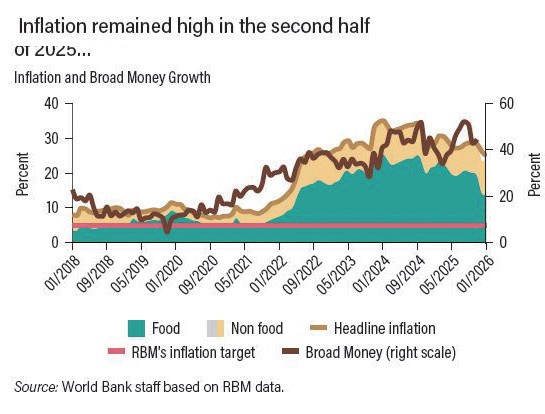
The Reserve Bank of Malawi (RBM) has revised its 2026 annual inflation projection upward to 24.8 percent, citing persistent risks that threaten to undermine efforts to stabilize prices. According to Nation Online, the central bank announced the adjustment in its first Monetary Policy Report for 2026. While the new forecast represents a decrease from the 28.4 percent average recorded last year, it remains significantly higher than the government target of 15 percent.
The RBM report indicates that while food inflation is expected to ease due to improved agricultural supply, non-food inflation will likely rise to an average of 23.7 percent this year. The central bank attributed this non-food inflation spike to ongoing cost pressures from recent fuel price increases, electricity tariffs, and indirect taxes. The central bank outlook is more conservative than a recent Economist Intelligence Unit forecast, which projected Malawi inflation could hit 29 percent due to global fuel price volatility, Nation Online reports.
Concurrently, a new World Bank report released this week lowered the 2026 economic growth forecast for Sub-Saharan Africa to 4.1 percent, pointing to global economic pressures including rising energy and fertilizer costs. According to CNBC Africa and Finance in Africa, the World Bank identified Malawi as one of several oil-importing nations particularly vulnerable to these external shocks. The institution warned that high debt burdens leave Malawi with minimal fiscal room to implement measures that would shield citizens from the rising cost of living.